Communications Manager
Community Outreach Coordinator
Jaime Arredondo at the 2024 Farm to School Institute retreat. Photo credit: Ben Anang
Jaime Arredondo (he/him) is the executive director of Capaces Leadership Institute based in Woodburn, Ore., as well as an Ecotrust board member. A few years ago, Capaces started Anahuac Farm, a 60-acre organic farm in the small town of Turner, Ore.
In this interview, community outreach coordinator Alisha Howard talks with Jaime about his personal connection to agriculture and the importance of Anahuac for connection to ancestral roots and community. All photos are courtesy of Jaime Arredondo.
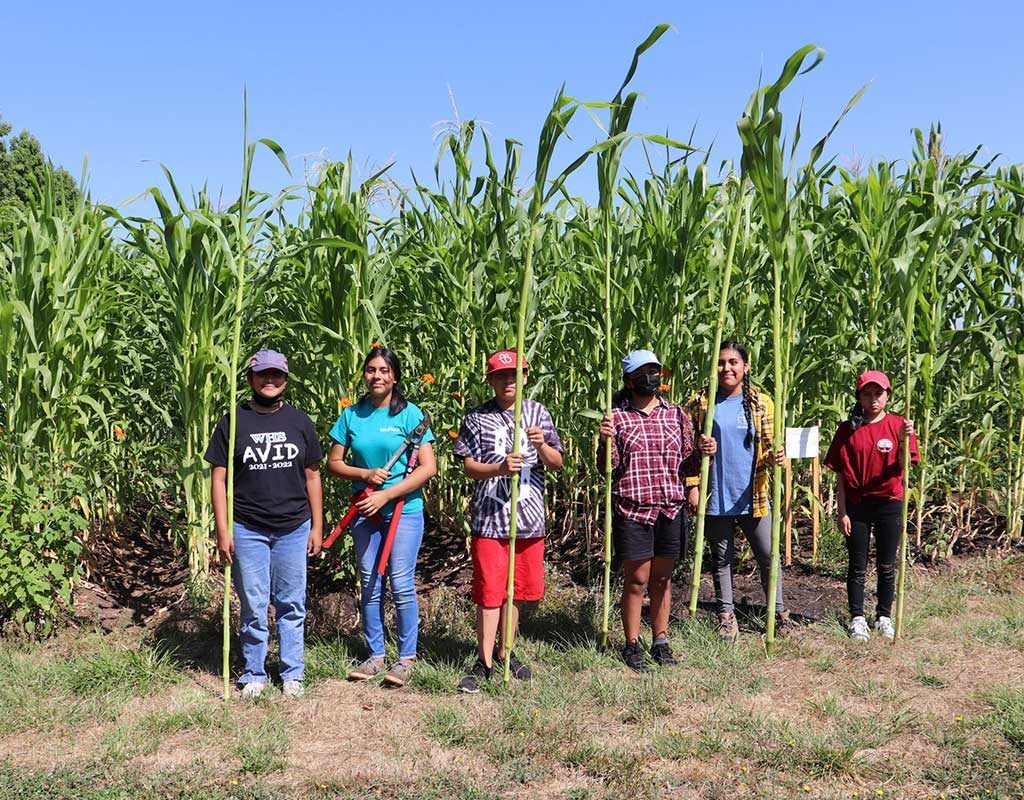
What we grow has always been the same, and it will remain the same: the three sisters—corn, beans, and squash, which are the staples of the Mexican diet. What we’re trying to do is grow it in an organic way and move it out to a community that’s been left out.
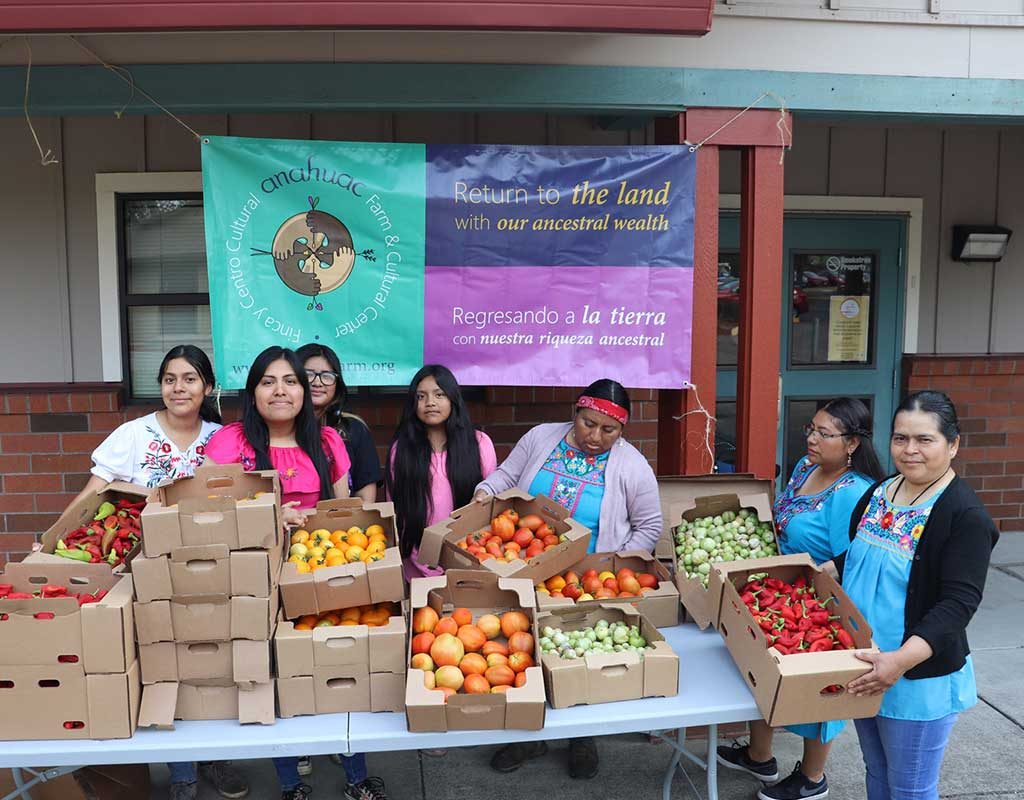
When you grow corn and beans and squash, other things tend to grow around it as well, complementary things. We have a ton of tomatillos, different chiles, and wild herbs as well.
A plant identification workshop held at Anahuac Farm.
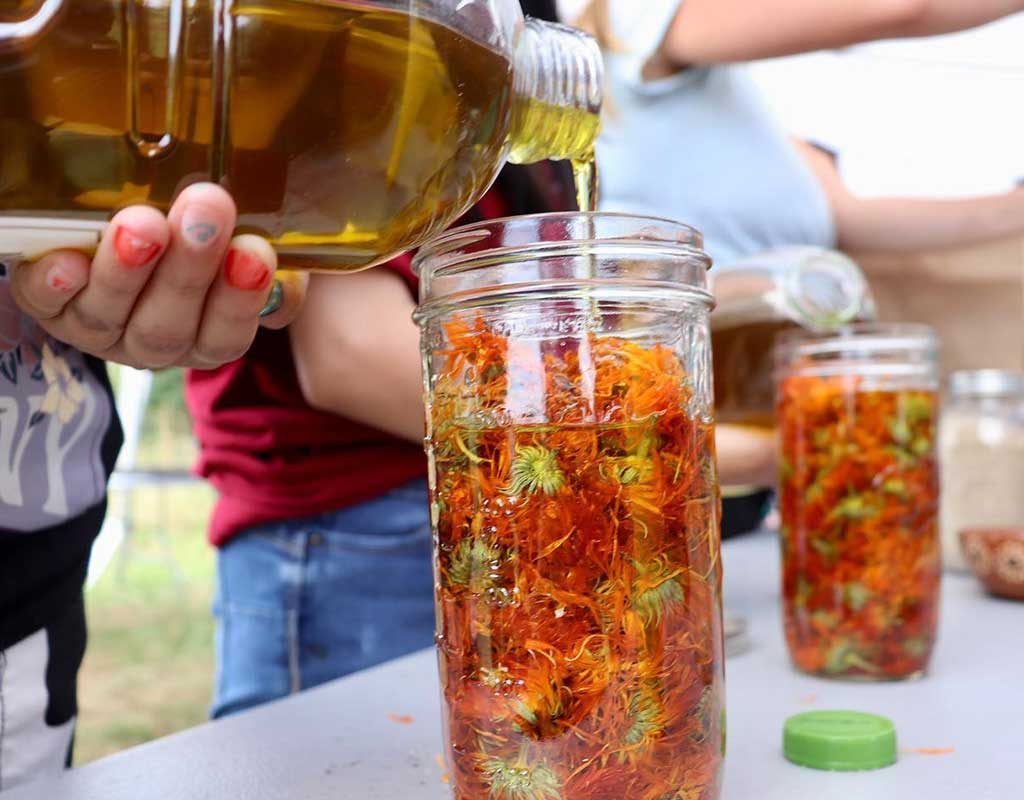
We also have a live-in pharmacy with both native plants and plants that our families have been using for centuries. We create a lot of things with the medicinal plants, from tinctures to creams to soaps. We’re in the infancy in terms of our production. We have 20-something types of corn, but only seven have adapted to our soil.
We don’t have a lot of infrastructure, to be honest. We need infrastructure to really scale up the planting, the harvest, and the distribution. And we’re working on that
It’s kind of an odyssey, really.
If you think about where I come from, what is known as the country of Mexico, a colonial project, it really has deep roots and years of history, of Indigenous traditions, one of them being agriculture. We Indigenous people from that part of the continent gifted humanity with corn, beans, squash, potatoes, tomatoes, and all sorts of things. We learned how to grow and consume those things in community.
There was a big rupture when the Europeans came, and we’re still recovering from that. That rupture created a lot of migration. Folks had to leave their villages and their farms to try to make it elsewhere, in places like this, El Norte and the Pacific Northwest, where they became workers, whether that was with the Bracero Program, the guest worker program, or as recent guest workers or migrants.
We’re still in that journey of being back in relationship with the land. We call it “returning to the land with our ancestral wisdom.” That’s what we’re trying to do.
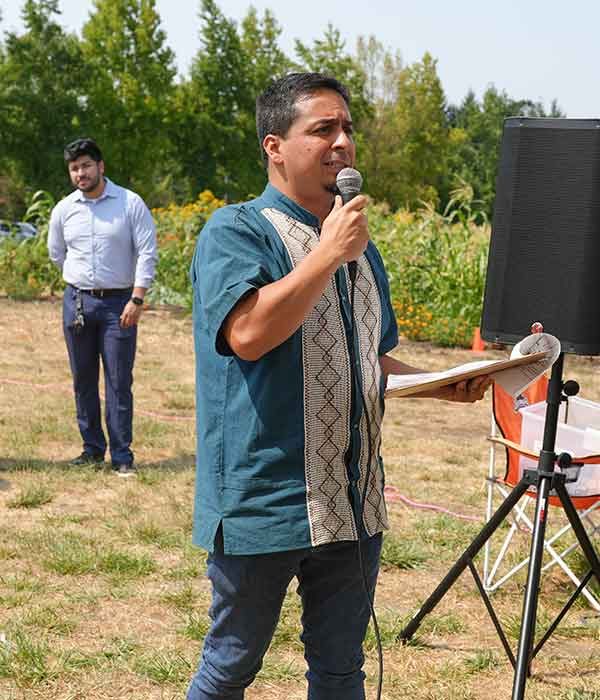
Jaime speaks at an event at Anahuac Farm.
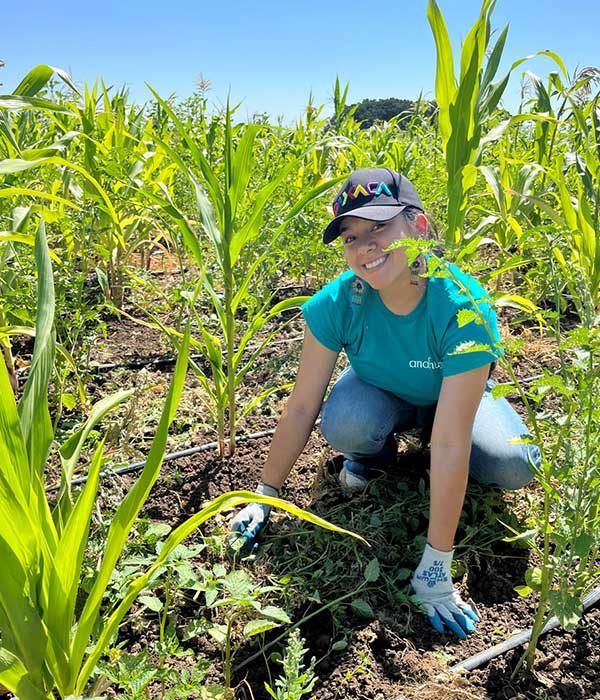
A volunteer at Anahuac.
The best way I can share this is to tell you a story that was passed down. It could have been somewhere down in the south, maybe in the west, maybe somewhere in the east. A very fruitful village where a child and an elder used to live with each other. The child was especially fond of the elder because the elder taught the child how to grow food, how to plant the milpa, how to sit down and relax, and how to be in prayer with the universe.
The child looked up to this elder. They would often tell the elder, “How do I become as wise as you?” And the elder would say, “Go to the well.” There was this deep well that people used to go to get their water. The child went to the well, and he looked at the well and saw it was dark. He goes back to the elder and says, ” I looked at the well. I can’t see anything. How do I become as wise as you?”
And the elder would again say, “Go to the well.” And so he went back to the well, back to the elder, and didn’t get it, right? Time passed, and the elder passed away, and it was really hard on the child. Eventually, the child had to leave up north. Some say the child wound up somewhere in Oregon, could have been Washington, could have been California…
The child grew up and made it big in this dominant culture—all kinds of titles and education and what have you. They were fulfilled with the “American way”. But one night, they were having a hard time sleeping. Maybe around three in the morning, their body just gave out. They fell asleep, and the elder came to their dreams. The elder said, “Did you find what you were looking for?”
All of a sudden, the child, now an adult, realized that the well was inside. It’s always been there. It’s been passed down from generation to generation. Despite the struggle of trying to acclimate to a new place and a new language, it’s always been there.
So I got to go back to the well. The well is deep. I grew up in a small village. I had to leave my grandparents, and I had to come up here for migration. I was treated very badly in the fields, as was my father and his peers. And I joined the farmworker movement to combat that. It led me to Anahuac Farm and this new way of life—which is not really new. It’s how we’ve always done it.

An herbal medicine workshop held at Anahuac.
Yeah, in our journey of figuring out what we wanted to do at the farm, we visited other places, in New Mexico, New York, and here in Oregon, you know, Wapato Island Farm, Zenger Farms… learning about what they’ve been doing.
And a lot of organizations, from Ecotrust to Chemawa Indian School. Even now, we have some work with [Native American Youth and Family Center], they’ve been sharing some of the ways we grow food. We have a sisterhood of organizations, Omar Grass and Noel Corporation, partnering with us to ensure we move product into community. And we also run a small farm out of Oregon Youth Authority, McLaren Youth Correctional Facility, up in Woodburn.
We can’t do agriculture without doing a ceremony, making sure that we’re always honoring folks who are still in this space. In our case, the Kalapuya people, who are still active through the Confederated Tribes of Grand Ronde. They helped us do ceremony. We have a sweat lodge, and the medicine to do the sweat lodge comes from the Crow Nation in Montana. So we’re always doing some sort of exchange, whether that’s on the food side of things or ceremonies and things.
We’ve had a lot of interaction, and that makes us feel like we’re part of something much bigger. There’s just no way we would do this alone. It takes a lot of folks to move things forward.
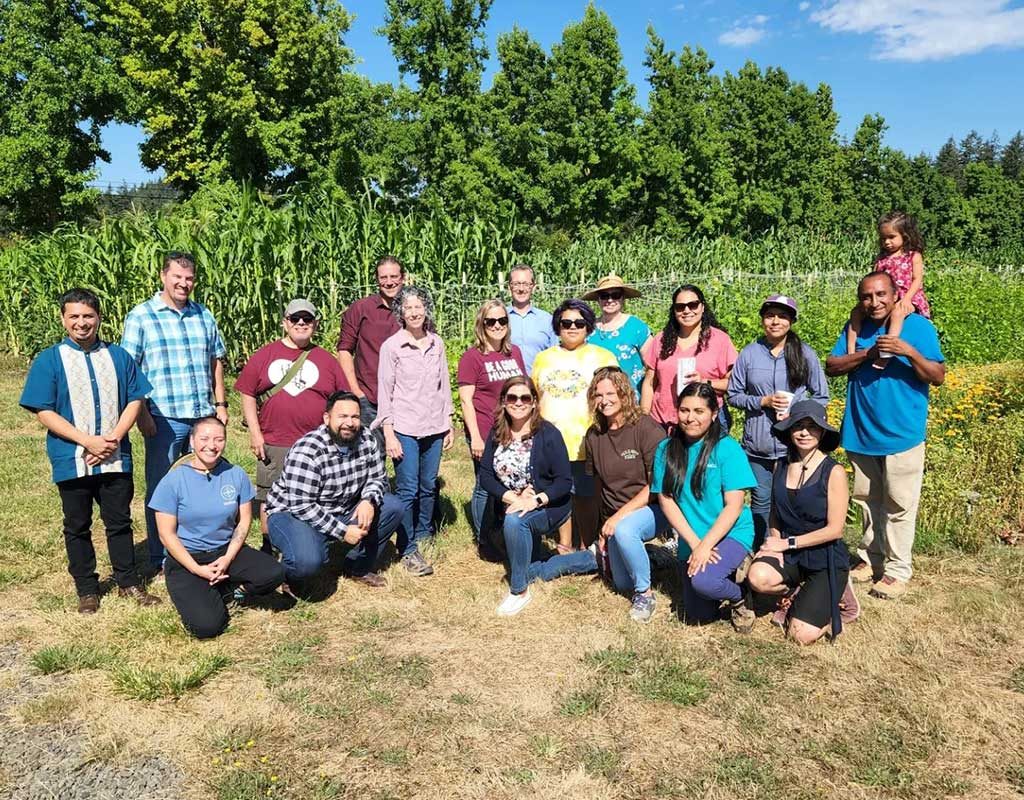
Salem-Keizer School District visits Anahuac Farm.
Yeah, wow. We thought that we’re there to give something, and it’s the other way around.
There’s a few hundred kids that are there, and they’ve had life circumstances and gaps and holes that we can fall through. One special moment that really stands out—we had a couple gangs that are pretty well known, and they participated in ceremony together, which they never had. These kids killing each other—a lot of harm, a lot of trauma—and yet earth brought them together. The medicinal plants brought them together. The sweat lodge brought them together. That’s a big deal.
We have a capital campaign that we’ve driven for a few years. The first part of that was acquiring the land. The next phase of that has to do with constructing a traditional kitchen and a bigger facility to process our products and distribute them. It’s been three years in, and we’ve been able to get a lot of support from a lot of folks, from philanthropy to monthly community brigades—folks coming out and helping us…. We’ve gotten some large federal grants that have been interesting, but a pain—we got to do this, you know, to make this happen. We’re also going to pursue legislative funding and the New Market Tax Credits program to speed up the infrastructure work.
This is why we’ve got to stay in ceremony and stay grounded, right? Because there’s going to be energy, and that could really bump us a little bit.
Nuevo Amanecer joins the community fall harvest at Anahuac.
As an executive director, I have to deal with so much stuff. Gosh, you know, institutions and bureaucracy. All these things just weigh you down. On the other side, the farm side, I was like, wow. Even if I’m not there every day, it just feeds me in such a powerful way.
In terms of my job and in the movement, you got to keep moving. I’m in a moment of transition; I’m what they call down in the South, a “yelder”: a young person but also an elder, hopefully down the road. I really take that to heart. I aspire to be an elder. Eventually, I’ll need to let go of what I’m doing and serve the greater purpose, whatever that might be.
Website