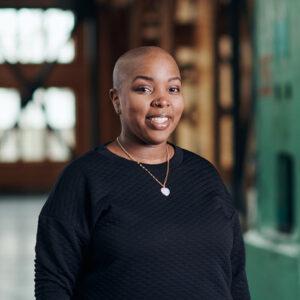
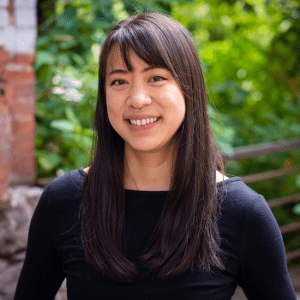
Tara Violetta is the farmer and founder of Sun Moon Fields, a mixed vegetable micro farm in Gresham, Ore. that specializes in mesoamerican crops that honor Tara’s Mexican lineage through their father’s side. In this interview, Tara speaks with Alisha Howard, Ecotrust’s Community Outreach Coordinator, about their journey into farming, their challenges as a small farm, and what keeps them going. All photos are courtesy of Tara Violetta.
What led you to farming?
I think I was 20 or 21, and I just had this feeling like things just felt wrong. I felt like the world was going to end. I felt like I needed to know how to grow food, but I didn’t have any experience [when I was] growing up. So my friend recommended a woman-owned farm. “You should ask her for a job.” So a month later, I went to her stall and bought a couple things, and I was like, “I want to work for you.”
She just went out on a limb—I think, because I was very ambitious—and decided to hire me. I ended up catching on very fast and worked there for two full seasons. But it was a pretty intense farm. So it burned me out, and I ended up quitting. And then I moved to Portland, because at that time I was belly dancing. My dance mentor was here. But I had it in my head to keep a dream alive of what my farm will look like in the future. I retired from dancing in 2018, and then that’s when I was like, “Okay, I want to start farming again.”
Not all of us heed our calling, even though it’s a really powerful thing. So tell us, why now?
A few years ago, I was doing some soul-searching and looking for ways to connect to myself. When I was growing up, we were the only Mexican family that I knew. There’s been a lot of assimilation, a lot of cultural loss, a lot of pressure to align with whiteness. I’ve seen the effects of that, not only the mental and psychological effects, but also the physical effects. My family’s pretty sick. Most people have diabetes, and there’s things we weren’t eating, like our cultural foods. I felt like growing plants and foods that my people have always eaten, that was my bridge to understanding myself. So for me, the plants have brought me back.
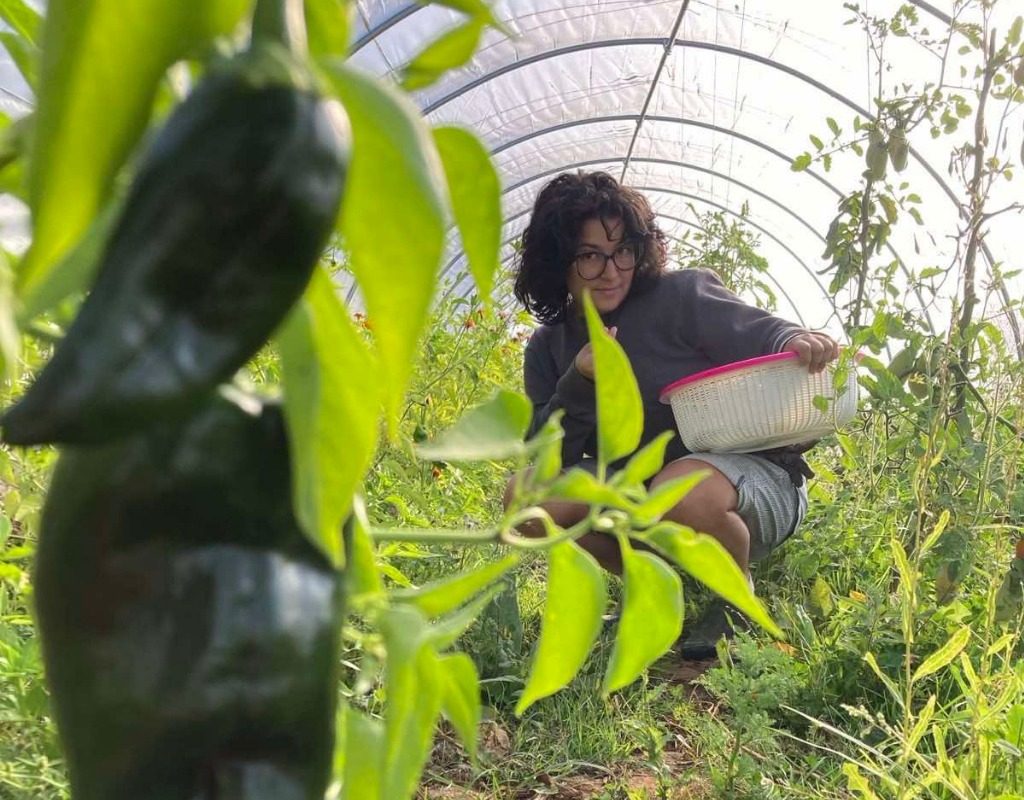
Tara picks peppers in a hoop house.
What are your goals?
I would love to be able to successfully grow plants that are from Mexico, Central America, and the Caribbean, in this climate, and this climate is changing—which does feel sometimes at odds with being a settler or guest on this land. These plants are not from here. But I also know that there have always been trade routes throughout Turtle Island, throughout the Americas. I would like to be able to successfully and sustainably, scale up and grow food—and to grow food with other people.
What are the hurdles that you’ve encountered?
There’s been a lot of challenges. When I first started my farm, I was [leasing land] on Wapato Island (Sauvie Island) with Raceme Farm Collective, and our landlord was trying to do illegal things. The choices he was making were impacting our farm, and so we decided to leave rather than endure what was happening. [He] essentially kicked us off the land. That was really bad and cost a lot of time and money for us.
It is a challenge to find farmland and to access it—to know who to talk to or who not to talk to. There are a lot of very old farmers out here, who are very connected to their heritage as settlers, in this way that feels like, “Oh, we’ve been here for five generations,” and there’s a lot of pride in that. I’m just like, I don’t know if you should say that out loud. You don’t really know who to ask around about leasing land. It does feel very cliquey, like you have to know somebody.
What is missing in terms of what farmers like yourself need to be successful?
For myself included, a reality check is missing. I don’t think small farms are prepared for what needs to happen in order for us to “change the food system.” The amount of food that I grow is probably enough for like three people to survive a whole year, if they were just eating my food. This entire economy is based off of slavery, and now the food system is based off of migrant labor, they have very few rights, and work extreme hours and in extreme conditions. There’s a disconnect with the amount of money that we spend on food [and what farmworkers are paid]. [Food] should be more expensive for the amount of time and labor that goes into it.
I don’t have the answer. I’m providing a small little niche, and I have the privilege to be able to access this land, but it’s a drop in the bucket as far as what we need to change everything. There’s this whole other avenue of owning land and what that means for generational wealth-building and all those things, but it just feels so inaccessible to a lot of people, myself included.
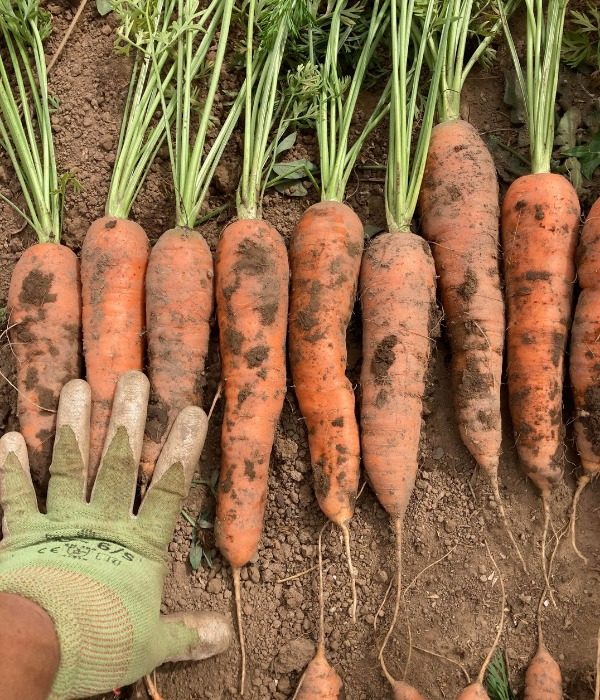
Laying out fresh picked carrots.
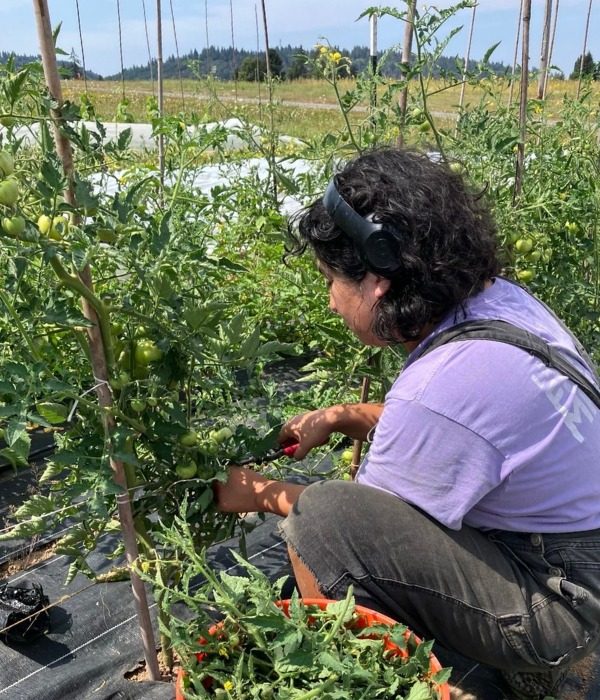
Tara prunes tomatoes in the sunshine.
Who has been part of your key support system?
I’m at Headwaters [Incubator Program] right now so the farmers here are part of my immediate support system as well as Jen Aron, who is contracted to provide help with soil health. And I work more collaboratively with Kasama Farm and Lomita Farm. I wouldn’t be here farming right now if it wasn’t for letty martinez from Flying Dogheart Farm and shiny flannery, who’s now working with Black Food Sovereignty Coalition and the Black and Brown Herb Exchange. She initially [invited me] to join Raceme Farm Collective. [And Duane Lane and I were] part of the Wisdom of the Elders business incubator four years ago. He just really uplifts me, and so I really appreciate his mentorship and friendship.
What has been rewarding about your farming journey?
Last summer, Alma [Gaeta] from Peachwood Orchard and Leilani and Jihelah from Kasama Farm invited me to join them at Mercado de Valle in Odell, Ore. It’s a very small farmers market that centers the Odell migrant farmer community, so a lot of people are selling cultural foods. I was able to bring a lot of cultural vegetables, and people were very excited about it. And because of the Local Food Purchasing Agreement (LFPA) grant, I was able to offer the vegetables for free. That felt really wonderful to make that connection, “Okay, I am growing food that means something to people.” This did make an impact, and that makes it worth it to me.