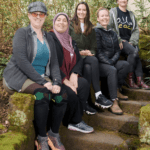
Tending the Tides episode 6 cover art. Illustrations by Tony Sterling. Photo of the Three Graces by Emilie Chen
In this episode of Tending the Tides, Jon and Kaitlyn sit down with Cheryl Chen, CEO and co-founder of Salmon Returns, to explore the emerging world of stewardship credits and what they could mean for coastal communities. Cheryl redefines how we think about underwater infrastructure, reminds us that ecosystems need “preventative care” just like humans, and presents a vision for the Oregon coast where capital flows directly to the people stewarding our lands and waters.
Guests: Cheryl Chen, CEO and Co-Founder of Salmon Returns

To learn more about stewardship credits, check out these resources:
– Can ‘Biodiversity Credits’ Boost Conservation?
– Biodiversity Credit Alliance
View Cheryl Chen’s slide deck from the Mariculture Future Forum.
This episode was hosted and written by Jon Bonkoski and Kaitlyn Rich. Edited by Suzie O’Neill, with production support from Megan Foucht, Emilie Chen, and Tyson Rasor.
Music by Imagined Nostalgia, Boxwood Orchestra, and Our Many Stars. Illustrations by Tony Sterling and design by Heldáy de la Cruz.
This podcast was made possible by our funders at Builders Vision Philanthropy; Builders Vision invests in and collaborates with nonprofits, businesses, and others working towards sustainable solutions to societal and environmental challenges. Finally, this podcast is a production from Ecotrust, where we work in partnership at the intersection of equity, economy, and environment. Learn more at ecotrust.org
Cheryl: We start from a simple, but also quite transformative idea, that stewardship and care is economic infrastructure and a business model. If we can pay for roads and power lines, because it keeps society functioning, we can and must pay for ecological care.
Introduction
Kaitlyn: Welcome back to Tending the Tides. I’m Kaitlyn Rich.
Jon: And I’m Jon Bonkoski. Today, we’re pivoting our focus. We’ve spent a lot of time talking about the “how-to” and the “why” of growing food in the ocean, but today is really about how we value that work within our regional food system.
Kaitlyn: That’s right, and we’re going to hear a conversation that Jon and I had with Cheryl Chen, the founder of Salmon Returns.
Jon: As we’ll hear from Cheryl, we actually go way back—we worked together for over a decade here at Ecotrust.
Kaitlyn: And now she’s working to build a new model around a financial product known as a credit. Most folks will have heard of a carbon credit, and with Cheryl we discuss the idea of a stewardship credit. A stewardship credit is the same thing, except instead of focusing only on sequestering carbon, a stewardship credit focuses on continuous acts of care.
Jon: She brings this transformative idea that “care” isn’t just a volunteer effort—it’s actually economic infrastructure. Last November, Cheryl presented her work and these ideas at the Oregon Coast Mariculture Future Forum to a room full of mariculture growers, agency folks, and scientists. Her presentation captured the room’s attention. Everyone there started to see how we could tend to an ecosystem’s needs while funding that work beyond simply producing a commodity.
Kaitlyn: We’re going to dig into her model and see how Oregon can lead the way. One thing to note is that the concept of stewardship credits are complex and abstract. If these ideas are new to you, some of this information might be hard to absorb all at once. We’ll do our best to talk through these concepts and terminology as they come up. And there will be resources provided in the show notes, so you can dig int at your own leisure. Okay, let’s get into it.
Cheryl: My name’s Cheryl Chen. I’m a first-generation Taiwanese American. I grew up in the Bay area of California but am living here now in, Portland, Oregon.
I have to say, like coming on this show, it feels a bit like coming home because I basically grew up career wise at Ecotrust. Jon, you and I worked together for like, a decade plus side by side, to empower coastal communities.
But yeah, so after Ecotrust, I found myself actually moving more and more into finance work mainly because I learned that philanthropy is only, 3 to 5% of global capital, and that all this time in the NGO space, we really weren’t tapping into that other 95% of capital. And, there’s a lot of folks that I’ve met who wanna move their money to support good work on the ground, but just don’t have enough, visibility into moving that money. And so that, that just kind of blew my mind coming from the NGO space and, most of our time is writing grants. And that’s been the limiting factor. And so, that really led me to create Salmon Returns with my co-founder Donna Morton.
We started Salmon Returns in the middle of 2024. And we’re a financial intermediary, which is really just a fancy term to mean that we help bridge the gap between communities doing the important work of regenerating land and waters and biodiversity with the immense financial capital out there, that needs to be routed towards that work.
We start from a simple, but I think it’s also quite transformative idea that stewardship and care is economic infrastructure and a business model. If we can pay for roads and power lines, because it keeps society functioning, we can and must pay for ecological care because it’s essential to the health of our economies and of course to, to life itself. So that’s the premise of salmon returns.
Understanding Stewardship & Biocultural Credits
Kaitlyn: Thanks so much for sharing a bit about your background, Cheryl. Let’s start with the basics. What is a biocultural credit?
Cheryl: Yeah so a biocultural credit is a type of stewardship credit. And so stewardship credits are a verified unit of stewardship that has maintained or improved an ecosystem such as a watershed or a forest ecosystem or a coastal system. And so then a biocultural credit, which is a type of stewardship credit, but it’s one that also emphasizes the value of the cultural relationships and knowledge so really stewardship credits are a pathway to pay for the essential work of keeping ecosystem alive, not just extracting products from it.
Kaitlyn: A lot of folks have heard of carbon credits. How are biocultural credits different?
Cheryl: So we’ve learned a lot from the carbon credit market about what works and what doesn’t work. And so the difference between the two is carbon really focuses on one metric, a ton of carbon is their unit, which can create backward incentives. Like in an extreme example, if the goal is just to capture carbon, then someone could plant a monocrop of non-native trees somewhere, which would be catastrophic for an ecosystem.
And so biocultural and stewardship credits inherently recognize that nature is complex and interconnected. It really values the practice of stewardship and regeneration, not just a single metric. And unlike carbon credits, they aren’t offset, so they aren’t permission to do harm elsewhere. You can really think of stewardship credits as payment for the delivery of ecological services that are necessary for overall public and economic health.
Jon: Another difference between carbon credits and biocultural credits is a shift from “Additionality-Based” rewards—where you only get paid if you do something new—to “Practice-Based” stewardship. Can you tell us more about the difference between “additionality” and “practice-based” stewardship?
Cheryl: Yeah, this is such a good question. And really what I think sets apart stewardship credits. So additionality essentially asks what change compared to a baseline? Meaning you have to prove your actions caused a discreet, measurable and permanent change. And in an ecological system, for example, like a living ocean, that can be like trying to count the exact number of waves you personally cause across the whole sea. There’s tides, there’s storms, there’s currents. So isolating an actor’s perfect before and after impact is really unrealistic. It’s an impossible task actually.
And so when we design systems around that, we can end up spending more time and money on modeling and monitoring than on the stewardship itself. And we can unintentionally push people to focus on stewardship projects that are the easiest to measure instead of what actually matters most for ecosystem health. And so that’s why we emphasize practice-based stewardship credit programs.
And importantly, practice-based credit programs doesn’t mean there’s no measurement. We just don’t make stewardship depend on an impossible attribution problem. It rewards verified practices. And we track outcomes like, how are these stewardship practices playing out in the ecosystem.
Jon: Why is it so important to reward ongoing stewardship rather than just incremental change?
Cheryl: Carbon markets often pay only if you can prove that measurable, specific change. Kind of like only paying doctors when there’s a sick patient and their health improves. But ecosystems need preventative care. You wanna pay for the practices that keep the system from getting sick in the first place. And so that ongoing care is needed and needs to be valued and supported.
Kaitlyn: What are some of the key indicators that you look for? Can you share a couple examples?
Cheryl: It’s essentially tracking whether an area is becoming more biologically rich and functional over time. So for mariculture, one wouldn’t rely on a single metric. You would use a set of indicators and compare before and after and inside the mariculture area versus nearby reference sites because the ocean is naturally variable. These set of indicators could be species diversity and abundance, are we seeing more kinds of fish and invertebrates? And are key species showing up more consistently in the area? Another big one is recruitment and nursery function. Are juveniles and new settlers increasing in the area? Folks can also look at habitat function and structures, so like seaweed lines or shellfish gear can add three dimensional habitat, right?
And then, depending on your site, you can also include, water quality proxies, clarity, and turbidity, potentially dissolved oxygen, nutrient load because those tell us if the ecosystem conditions are trending healthier.
And at the end of the day, it’s really up to the community to decide on what metrics matter the most and are key indicators and are practical to measure.
And so this is really where local or community-based research or university partners can come in and partner up. ‘Cause they really can add that capacity and monitoring expertise in the region and can maintain that on the ground relationship and also start to create a longitudinal base as well of looking at over the long term, how is mariculture supporting ecosystem integrity along the coast
Jon: How does a model like the Salmon Returns ensure that capital actually flows back to the Indigenous stewards and local growers doing the actual work, rather than getting stuck in administrative layers?
Cheryl: Yeah, this is a really important part and really starts with flipping the usual order. So it’s about governance first and then finance second. And so ideally there’s a community governed entity. These are often led by the local producers or stewards. And this is the group that administers the credit program. And this entity sets the rules of the game. So like, you know, what does good stewardship mean in this place? What gets measured, who gets paid and how benefits are shared.
And then folks build the credit around that governance, so it’s transparent upfront where the money goes, to whom, on what schedule, for what work.
So in other words: the stewardship contract is written to route dollars to the people doing the care. It’s really helping communities rebuild decision-making power over shared infrastructure. Like in this case, it’s ecological infrastructure and shared capital flows. I really believe this is at the core of how we weave our communities back together and how we grow community power and be able to more and more self determine their future and build a future economy.
Relevance to Mariculture & Food Systems
Kaitlyn: Okay, so we’ve learned about what a stewardship credit is, why it’s important, and how a community might approach starting their own stewardship credit program. We’re essentially creating a financial product that allows money to flow to the people doing the care taking of an ecosystem and it should be designed by those people and for them. But, can you tell us more about how seaweed or shellfish farming provide the “underwater infrastructure” for a healthier ecosystem?
Cheryl: Yeah. I’ve been really loving redefining this word infrastructure. And we’re so used to thinking of infrastructure as like roads and bridges. But in coastal systems, the real infrastructure is living, right? It’s kelp forests, shellfish beds, seagrass meadows.
Because those are the things that hold habitat together. They serve as nursery grounds. They keep water conditions stable and they support the food web. And mariculture can mimic some of those functions. Seaweed lines can add structure and habitat. Shellfish can filter water and influence clarity.
Seaweed growth can pull in nutrients like phosphorus and nitrogen into its biomass, which can prevent harmful algal blooms. The point is that every farm isn’t automatically going to restore nature. It’s that with the right design, mariculture can be a managed piece of living infrastructure, and that the stewardship is the practice of keeping that infrastructure healthy over time.
Jon: And for an oyster grower listening in, how might these credits change their model? Is there a “competitive advantage” in selling an ecological outcome alongside a food product?
Cheryl: Yeah, totally. So credits essentially, create a second product. it’s a verified ecological service that can diversify revenue, support better practices, and attract buyers who want traceable stewardship.
As a producer, when kelp or shellfish prices drop, your costs don’t drop with them. Credits help because they can help pay for the part of the job that never stops, which is the ongoing skilled stewardship that keeps the farm and the surrounding ecosystem healthy, whether or not you’re harvesting.
It’s really about the business resilience because you have a product revenue, plus stewardship revenue, and the cost of that stewardship isn’t passed on to the consumer. Potentially pricing you out of a market. It’s paid for through a different mechanism that recognizes the overall public health it’s providing.
Jon: We’re jumping in here to provide a bit more context around how credits provide a second revenue stream, because the buyer of credits might include more than an individual consumer. If we shift our thinking on what is infrastructure and include mariculture and ecosystem, we get back to this idea of ecosystem services that Dr. Sara Hamilton, Tom Calvanese, and many others we’ve interviewed on this podcast have pointed out.
So, just as an example, kelp forests help protect the coastline from storms and erosion, while also providing oxygen and critical habitat for fishes and other marine organisms. Our coastal communities need these things to live and thrive. Buyers of stewardship credits are the ones paying into the system and ultimately providing income to those performing the stewardship activities. Buyers could range from individual consumers, like you and me, to cities or states to large corporations or philanthropic initiatives.
Advancing the Model in Oregon
Jon: During your presentation at the Oregon Mariculture Future Forum, you encouraged us to make the Oregon coast a “global example” for this work. What do you think makes our coastline and the communities there particularly well-suited for a stewardship-based credit market?
Cheryl: Jon, you and I have spent a lot of years walking the docks and along the port communities of Oregon. There’s a strong coastal identity here, a dedicated community of producers, university partners, Sea Grant, state and county agencies, associations, co-ops, NGOs.
I could just go on like we’ve worked with all of those folks for years. You have a great mix of people who are already used to working with each other. And thus you have this convening power, this institutional capacity to design and run a credible pilot. Like I really feel like the community fabric is already there.
And that’s huge. I think there’s like this fierce love of place on the Oregon coast, When people care, they mobilize. I feel like Oregon could really lead in, in a global example of what this could look like.
And I will say too, this is really why I started Salmon Returns, during my time at Ecotrust. We lived and breathed the power of community, like we bore witness to it every day. And it’s really the flow of financial capital I think that is a limiting factor and we really gotta help get it unstuck.
Kaitlyn: I think policymakers can probably help support this work to get the capital unstuck and start flowing. For the policymakers who are listening, you’ve talked about a “marine ecosystem-services credit” working group. Can you share why this would make meaningful change on the Oregon coast? And what do we need right now to make this real now?
Cheryl: Yeah, a working group is, essentially how it can move from a great idea to something real and scalable. And so if it were me it can do a few very practical things like first it would define the credit categories. What exactly are we paying for on the Oregon coast: habitat function, biodiversity support, water quality benefits, resilience, those kinds of services, and just really defining what those are and what the needs are on the coast.
And second is: what’s the set of right-sized monitoring and verification standards? Something that’s rigorous enough, to demonstrate integrity, but not so expensive that it eats up the whole, credit value.
And third is: I would establish governance and benefit sharing norms so that it’s transparent. You know, who administers the program, where the money goes, if there’s extra money from the credit, how, where that goes and how decisions are made around that. And yeah, ensuring that local producers and indigenous communities and all sorts of different stakeholders, that are in it with everyone else that are centered in decision making and benefits that it’s truly a community-led process.
And then I would do the market making work: identify buyers, be it the public, maybe it’s a state or a county agency, philanthropic, like a, a foundation or private, major donors or something like that. And clarify why they should pay or why would they want to pay and what benefits they get in terms of attribution or getting to be part of the story of this credit program.
on the policy side, really important, like it can really help set targets and incentives.
For example, a state or county can set goals for coastal ecosystem function and incentives for businesses to participate in a credit program. So that demand isn’t purely voluntary, and it starts to really become just a standard part of doing business. Policy is gonna be really key in moving this towards the new business as usual model. from this working group, pick one, two pilots.
Define clear success metrics. And so within 12 months of the pilot operating, you then have a credible demonstration that Oregon can scale. Yeah, I think it’s possible. I know that Oregon can do it.
Closing
Jon: I absolutely loved that conversation with Cheryl. It is incredibly inspiring to hear her map out exactly why the Oregon coast is the perfect place to build a stewardship credit. We have something special here—a deeply rooted coastal identity backed by a powerful network. We have active, sovereign Tribes, a dedicated community of producers, world-class university partners including an excellent Sea Grant program, state and county agencies, industry associations, co-ops, and committed NGOs. That entire ecosystem is ready to serve as the network to lift a model like this off the ground.
Kaitlyn: Yeah, and I think from my perspective an important step that we’re focused on here at Ecotrust is building the connective tissue that helps mobilize these innovations and capital. Over our history, we’ve found success with building networks of trusted relationships that bridges the gap between state-level strategy and local agency. By centering relationships and connections, we transform isolated efforts into a cohesive, participatory ecosystem, shifting the focus from natural resource extraction to a resilient, Triple Bottom Line economy.
Jon: Beyond those relationships, I am also still thinking about Cheryl’s description of mariculture as underwater infrastructure. That is such powerful framing. If we begin to view kelp forests and shellfish beds as essential natural infrastructure—things we collectively invest in because society depends on them—it completely flips the script. It fundamentally changes the entire business model for a grower from merely selling a product to anchoring an ecosystem.
Kaitlyn: I love that framing too. And I think part of the reason it’s so powerful is because we all know what it’s like right now to exist in an extractive, commodity-based economy and there’s a lot of energy to start shifting towards a reparative economy.
Jon: Right, and Cheryl’s model uses the term “regenerative economy,” but I’m hearing you say reparative. Why those words?
Kaitlyn: Yeah, so I think regenerative and reparative are similar terms. But a reparative economy is going to be one that acknowledges the extraction and harm caused in our current paradigm. And by acknowledging that, we know that it’s gonna take effort to repair our ecosystems. And I think that should signal to all of us that the return on investment, or ROI, for a stewardship credit is going to be having cleaner water and inviting back biodiversity into these places that are so out of balance.
Jon: Cheryl mentioned that for any pilot project, it’d be important to secure buyers. I want to dive into what would motivate a buyer to purchase credits and how credits can help us shift our perspective on ROI here. And I guess what I’m thinking about is my own personal journey on this idea. As a human living on this planet I very much have an interest in perpetuating and improving ecosystems so that future generations can live and thrive here. I have children and I very much want to leave them and their kids something better than what we have, so to me investing money in outcomes that result in perpetuating life—clean air, clean water—on this planet seems very much worth it, and I want to create ways of measuring that and showing what an expanded ROI means.
Kaitlyn: Right, that’s why it’s important that we invest in repair now and how it sets us up for future returns both ecologically and monetarily. So, I find this idea of repair really powerful. And one of the ways we’re working towards repair at Ecotrust is by capitalizing a reparative loan fund, which we’re calling the Upwell Community Capital Fund.
While we’re still fundraising and designing, the fund’s purpose is to lend to Ecotrust community partners out there doing the work of repair—whether it be in our forest, our oceans and rivers, or on land. Another key aspect of this repair work is ensuring that those who have been historically denied access to capital and resources, are not only prioritized, but that the fund is designed to meet their needs as a reparative action.
Jon: That’s really cool, and I love that Ecotrust is doing that work. Cheryl emphasized “governance first, finance second,” where the community informs and leads the design of the credit program before capital flows. Upwell uses a “reparative” lending model, so beyond funding others to do repair work–what are some of the reparative practices of the fund?
Kaitlyn: Like Cheryl outlined in the model for developing stewardship credits, we’ll also start our design process with talking to the communities and projects we’re serving and lending to. We want to understand their current barriers to accessing capital, like loans, and then rethinking and removing those barriers.
So, for example, we’ve heard from partners on the East Coast that it’s difficult to collateralize loans to oyster farmers, because the resale of oyster farming equipment is nil. And, actually this is true in most cases, as repossession of collateral when a loan isn’t repaid doesn’t result in those “lost funds.” Instead, what if we collateralize a loan to an oyster farmer based on their continuous acts of care and stewardship of the ecosystem they farm in?
One way we could do this would be to sell stewardship credits on the behalf of the farm, to investors, community members, and philanthropic partners who are motivated by reparative economics and paying for our natural infrastructure, to reach the collateral requirement. Or, we could simply get rid of that requirement, too.
Jon: We have to be willing to rethink what has value. Is it financial returns and wealth hoarding, or is it the health and wealth of people and place? which are at the center of thriving economies. It occurs to me that this question is really the central debate of our time. Capitalism as it’s practiced currently relies heavily on an endless number of externalities that can no longer be ignored. We have to pay for the world we want and its really up to us to create the infrastructure—human, natural, and physical—to transform our economy to be more just, equitable, resulting in greater health and wealth for people and place.
To our listeners, if you want to go deeper and continue your learning about the information we’ve discussed, you can find Cheryl’s full presentation from the Future Forum in our show notes. You can learn more about Salmon Returns by visiting their website, www.salmonreturns.com. Until next time, keep on tending the tides.

Blog

Project
A podcast exploring how mariculture on the Oregon coast can build community wealth, an equitable economy, and climate resilience.

Website
Regenerating place, culture and economy
We are a place-based financial intermediary that works across the US and Canada to support Indigenous and community-led initiatives that restore ecosystems, strengthen self determination, revitalize local economies.