Patrick Roelle of Fishpatrick’s Specialty Canned Tuna has been selling his wild-caught albacore tuna to schools since 2024. Hear how he began building relationships with schools (including his first customer Reedsport School District) and early childhood programs across the state, and increased his farm to school sales.
Patrick Roelle of Fishpatrick’s Specialty Canned Tuna in Reedsport, Ore. has fished and worked on boats since his youth and started selling his tuna products to schools in 2024. When the Highwater Cafe and Market in downtown Reedsport posted on social media about their tuna melt featuring Fishpatrick’s tuna, the food service director at Reedsport School District, Thomas Kyelberg, reached out to Patrick.
“After meeting him, I discovered that he wasn’t quite familiar with Farm to School, so we sat down and had a wonderful chat,” said Thomas. The food service director explained how the Oregon Department of Education (ODE) Non-competitive Reimbursement Grant program works and determined with Patrick that Fishpatrick’s tuna is an eligible local product to purchase with the district’s grant money. This grant program reimburses participating schools for their purchases of Oregon grown and processed foods. Thomas also helped Patrick sign up to be listed on the Oregon Harvest for Schools Directory, an online database that school food buyers can use to find Oregon producers who are ready to sell to schools.
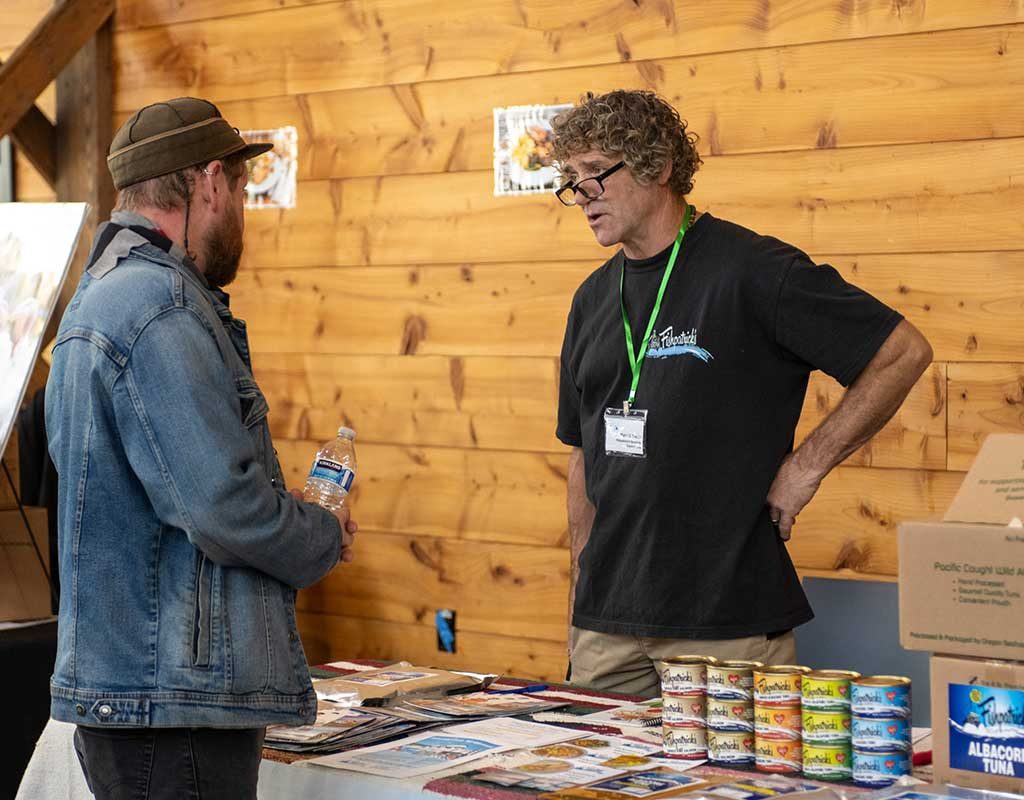
Patrick speaks with an attendee at Local Link, a vendor fair dedicated to connecting food businesses with school buyers. Photo credit: FLI Social
Thomas says many of his neighboring school districts are also interested in local products and offered to call them to promote Patrick’s tuna. Patrick immediately jumped in and supplied samples to other school districts.
After connecting with Thomas, Patrick also started working with his regional procurement coordinator, who distributed tuna samples on his behalf and connected him with additional school nutrition staff in the area.
One of the biggest obstacles with which Patrick struggles when selling to schools is needing to spend money in advance to prepare his products for the school marketplace. In anticipation of selling to schools, Patrick had to first pay for his tuna to be processed into four-pound pouches.
“So the biggest hurdle for any of us, whether we’re raising cattle or carrots or corn or catching fish, is not to receive that money… So now I get to write a check for a considerable amount of my own money or line of credit to get my tuna back,” Patrick said. “Before I realize a single dollar, I haven’t paid for my fuel, I haven’t paid for my mortgage, I haven’t paid for my boat payment.” Producers can apply for Oregon Department of Agriculture’s Farm to School Equipment and Infrastructure Grant Program to fund eligible equipment and infrastructure costs related to selling to schools and ECE programs, but funding is limited.
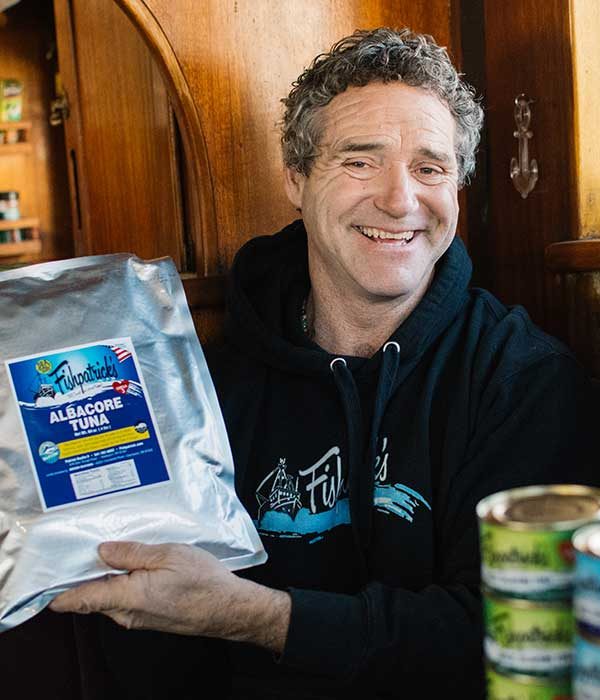
Patrick poses with the pouch-packaged tuna, which he sells to schools and institutional buyers. Photo credit: Emilie Chen
To help facilitate sales, Patrick has offered to personally deliver his tuna products to schools and visit classrooms and cafeterias. He even bought a box truck to be able to deliver pallets of tuna to schools in anticipation of future sales. Although he is willing to deliver, it can be time-consuming for him to make multiple separate deliveries to schools that are in the same area.
“I don’t expect them to communicate with each other to try to make it easier for me, but I would hope that they give a producer a lot of time to understand their request,” said Patrick.
Local producers like Patrick lack the stability that comes with having purchasing contracts with schools, which would give them the security and predictable schedule of guaranteed sales.
“A lot of this is just hope and prayer and faith because I have no contract. They could change immediately. I could be left holding after spending a lot on processing and putting aside a very large amount of product,” said Patrick.
If Patrick is still struggling to sell his tuna after all the calls, emails, and preparations he has made for his tuna products to be ready for the school marketplace, he says he will distribute his fish elsewhere.
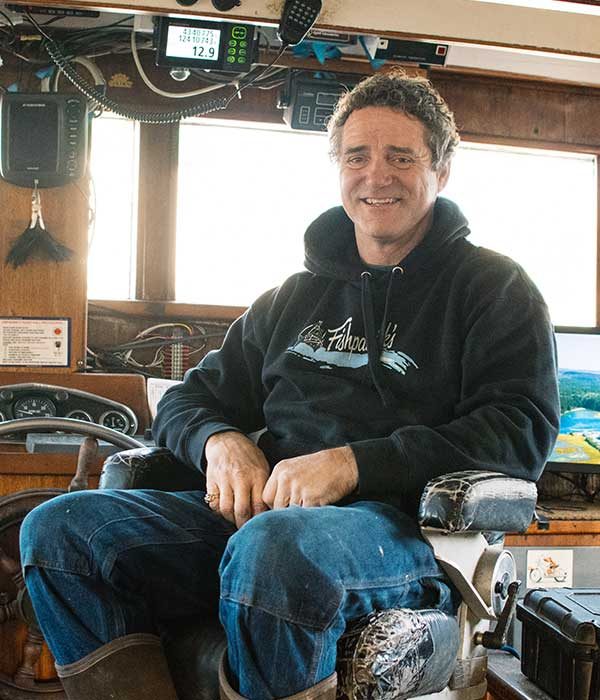
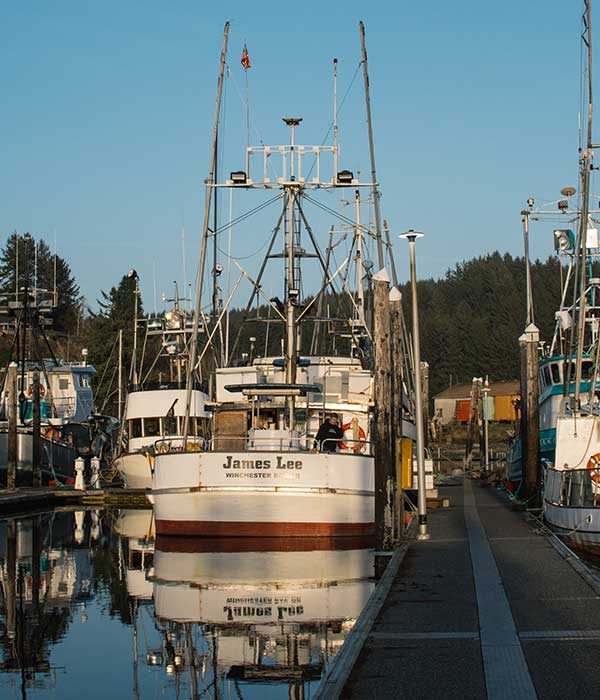
Patrick sits in the captain’s seat of his boat, the James Lee. Photo credit: Emilie Chen
Photo credit: Emilie Chen
“If I put this up, get it all lined up, and end up the school districts have nobody to buy it, or they refuse, or something along those lines — it happens. Then I’ll either find somebody that will buy it, or I’ll give it to the food bank, you know, and move on and be happy,” said Patrick. “I just crack my knuckles and figure out who could best use it and make sure that it gets there, you know?”
Although school sales in 2024 were slower than he would like, Patrick saw the promise and value of continuing to pursue farm to school sales. He has continued building relationships with schools and early childhood programs, and now in 2026, Patrick says schools have been purchasing tuna from him at about the same rate he is capable of producing it. Students in 19 districts and two Head Start programs across the state are now able to enjoy Fishpatrick’s tuna.
“This [fishing] is my passion, and I like to know who’s eating it. I like to know where it goes. And I like to see the satisfaction… And I like to tell my story to them if they want to hear it.”