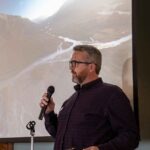
Tending the Tides bonus episode. Illustrations by Tony Sterling. Photo of Nate Jones by Emilie Chen
In this bonus episode of Tending the Tides, divers share what it’s really like to harvest purple sea urchins beneath the rough waves of the Oregon coast. Through conversations with Brad Bailey and Nate Jones, we learn about the physical intensity and technical skill behind this work—from battling powerful surge to spending hours tethered below the surface.

This episode was hosted by Tyson Rasor. Edited by Suzie O’Neill and written by Emilie Chen. You can learn more about OoNee Sea Urchin Ranch at www.oo-nee.com.
This podcast was made possible by our funders at Builders Vision Philanthropy. Builders Vision Philanthropy invests in and collaborates with nonprofits, businesses, and others working towards sustainable solutions to societal and environmental challenges.
Teaser video for “What it’s like to dive.” Narration by Nate Jones. Photos by Emilie Chen.
Tyson: Hey it’s Tyson Rasor, from the Tending the Tides production team at Ecotrust, back with another bonus episode! So in our last episode, the one titled “An Ecosystem Balancing Act”, we heard a lot about purple sea urchins—how the overpopulation of purple sea urchins has devastated kelp forests in California and Oregon. We also heard from some of the small businesses and researchers that are exploring solutions to that problem here along the Oregon coastline. And those solutions, they require diving in the open ocean, as somebody has to go down there and manually remove these urchins by hand.
Brad: Oregon is one of the tougher places to dive. We’ve got the swell that comes in, it’ll throw you back and forth 10 feet under water. As you’re getting real shallow, it gets worse and worse because of the scouring of the surge.
Tyson: That was Brad Bailey, the Co-Founder, Chief Technology Officer, and commercial diver at OoNee Sea Urchin Ranch, who was also in our last episode. We heard from a few of our interviewees about the physical intensity of urchin diving, and we wanted to share a bit more about that: What is it actually like, collecting urchins below the rough waves of the Oregon coast?
Brad: I absolutely love. Getting in the water, crawling around, under the rocks down there. It’s just really fun.
As the wave comes in, it pushes you in, then it sucks you back out again. So there’s a bit of a learning curve on that. And then Oregon is blessed cursed with upwelling that really, uh, brings all the nutrients from, uh, the deep water up into the shallows. So the kelp grows nicely, everything grows nicely, but uh, the visibility sometimes is, uh, about two feet.
And so you kind of have to anticipate getting slammed up against a rock when you can’t see it. So, it’s very challenging, but like I say, it’s really fun. I mean other than … urchin diving is just a riot.
Tyson: We heard about this when we talked with Nate Jones, the chief scientist at a company called Oregon Seaweed, who is also a commercial diver and urchin harvester with Brad for OoNee Sea Urchin Ranch. So let’s tune back into the conversation we had with him:
Tyson: I’m wondering what’s drawn you into this work and how long have you been doing it for?
Nate: I’ve been doing, scientific diving and invasive removal for over six years now. I started commercial fisheries about five years ago. But I’ve really been focused on urchin removal for the last three years.
Tyson: And I’m wondering if you can describe to everyone out there: a day in the life as an urchin diver, what does that look like? And can you talk about any of the physical demands that requires of you?
Nate: Yeah definitely. Our days are largely based around the tide. We have to time our boat exiting the harbor and going out into the ocean based on whether or not the tide is coming in. Holding steady or going back out. But usually we try to time it as close as we can to dawn. We like to get up bright and early, just when there’s enough light to run the boat.
While we’re at the boat, we like to check all the equipment at the dock, make sure that my breathing app apparatuses are working so that we don’t have an issue when, once we get offshore. Then we’ll have a nice two-hour-long transit sometimes to dive sites, which is a perfect time to drink some coffee, get yourself in the head space to go diving.
Once on-site my top side will prep the boat to receive urchin while I put on my wetsuit. I have a 50-pound weight harness, and then I have some collection bags and a hook that I can use to collect the urchin. Then once we get all that together, I’ll jump in the water, and I can be down for several hours.
Tyson: And just like Brad was saying earlier, Nate will tell you about how tough it is, once you’re under the water:
Nate: So that 50-pound weight harness really helps hold me in place. I’ll also use a lot of rock climbing techniques to hold myself down into the rocks. Otherwise, the surge can push you 10 feet to one side of another and when you can only see about five feet ahead of you, uh, you never know if you’re gonna fly out off the rock shelf. Or you’ll be slammed into a rock.
Tyson: Can you talk a little bit about how, how far down you might dive in any given location and you know, you’re down there, you’re pulling these underwater rock climbing moves?
But how do you also, when you’re down there holding on underwater for hours at a time, how do you connect to oxygen? How do you breathe while you’re down there for hours? What does that look like?
Nate: Yeah. Yeah, definitely. When people think about diving, they often think about Scuba Steve, a guy with a tank on his back, with a regulator in his mouth, not attached to anything. That kind of diving doesn’t hold enough oxygen for the kind of work I’m doing, where I need to be down for several hours at a time.
I’m actually connected to the boat through a surface supply line and umbilical cord that is constantly compressing air on the boat and sending it down to me. That also has the added safety of I’m always attached to my boat. And if there’s any issues with me underwater, my top side can pull me back up.
Harvesting urchin, I’ve gone as deep as 60 feet. There’s other urchin divers that will go down to 90 feet. The positive thing about the harvest is they tend to like shallower water. So most of the time I’m more concerned of how deep are the waves going, because I need to be deeper than that. So I’m not getting crushed against the rocks. So often I’m about 10 feet deep to 30 feet deep, primarily.
Tyson: In our previous episode, we talked about the overpopulation of purple sea urchin. There’s a lot of them out there. Here’s Brad again, talking about how much urchin they can collect in a single outing:
Brad: So, we go down with a small bag. Normally, the divers will take a big bag and try and do 300, 400 pounds at a time. And most of the guys are so experienced that they use just fins. No comms or anything because you know, they’ve got years of experience. They know how to get the stuff done and bring it back.
So you use hose pulls for signaling. The diver will pull the slack out of his hose, give you a three pull, which means “send me another bag” and then you do a bag exchange. Send an empty bag down to the diver with a line hook to it. Diver takes the new bag, clips the line onto the other bag, inflates the buoy ball or airbag on the bag, sends it to the surface, and the tender will pull the bag to back to the boat and board it.
Tyson: So in a single dive, a few hundred pounds of urchin can be removed. And Nate Jones estimates he’s probably removed 10,000 pounds of urchins in just one of his diving spots. He says it’s like a “never-ending stream of urchins.” With so much work to do, what keeps him going?
Nate: When I started diving in 2014, I was doing survey training with Humboldt State, and I saw in my first few dives, a lot of beautiful kelp forests. That quickly started disappearing. A few months after my scientific certification started, sea star wasting syndrome began, where sea stars were literally—their arms were melting off of their bodies. And it affected the populations offshore a lot. We saw loss of over 90% of sunflower stars within a three-week period. And as a result of that being the last predator of urchins, the urchin populations exploded. And just voraciously started eating all of the kelp. There was actually a report that came out in fall of 2024 from the Oregon Kelp Alliance showing that we’ve lost 70% of our kelp forest to urchin barrens. And I really want to see those kelp forest restored because they’re a very important part of our near shore ecosystems.
Tyson: You can dive in yourself and learn more about the mariculture Brad and Nate are doing by visiting OoNee Sea Ranch at oo-nee.com and Oregon Seaweed at oregonseaweed.com.
This episode was hosted by Tyson Rasor. Written by Emilie Chen and edited by Suzie O’Neill, with production support from Megan Foucht, Kaitlyn Rich, Tyson Rasor and Jon Bonkoski,. Music by Imagined Nostalgia and Boxwood Orchestra. Illustrations by Tony Sterling and design by Heldáy de la Cruz. This podcast was made possible by our funders at Builders Vision Philanthropy; Builders Vision Philanthropy invests in and collaborates with nonprofits, businesses, and others working towards sustainable solutions to societal and environmental challenges. Lastly, this podcast is a production from Ecotrust, where we work in partnership at the intersection of equity, economy, and environment. Learn more about Ecotrust at ecotrust.org.

Blog

Project
A podcast exploring how mariculture on the Oregon coast can build community wealth, an equitable economy, and climate resilience.

Website