For Thomas Kyelberg, food service director at Reedsport School District, incorporating local ingredients into his school menus allows him to support producers in the community (like local Reedsport fisherman Patrick Roelle), and offer students more nutritious and culturally diverse foods. Learn more about how he builds relationships with local producers and the importance of farm to school funding.
“We don’t talk budget with the kids. They’re hungry, they eat.”
Thomas Kyelberg, food service director at Reedsport School District, purchases local foods not only for student nutrition, but also because he sees local procurement as an opportunity to help local businesses, especially relevant against the backdrop of economic downturn in the Reedsport area in recent years. Through the support from Oregon Department of Education’s Noncompetitive Reimbursement Grant (NCRG), which reimburses participating schools for the purchases of Oregon grown and processed foods, Reedsport students can enjoy everything from organic blueberries from Estill Farms to tuna from local Reedsport fisherman, Patrick Roelle of Fishpatrick’s.
When Thomas saw on social media that Highwater Cafe and Market in downtown Reedsport featured tuna from local business Fishpatrick’s in their tuna melt, he reached out to Patrick.
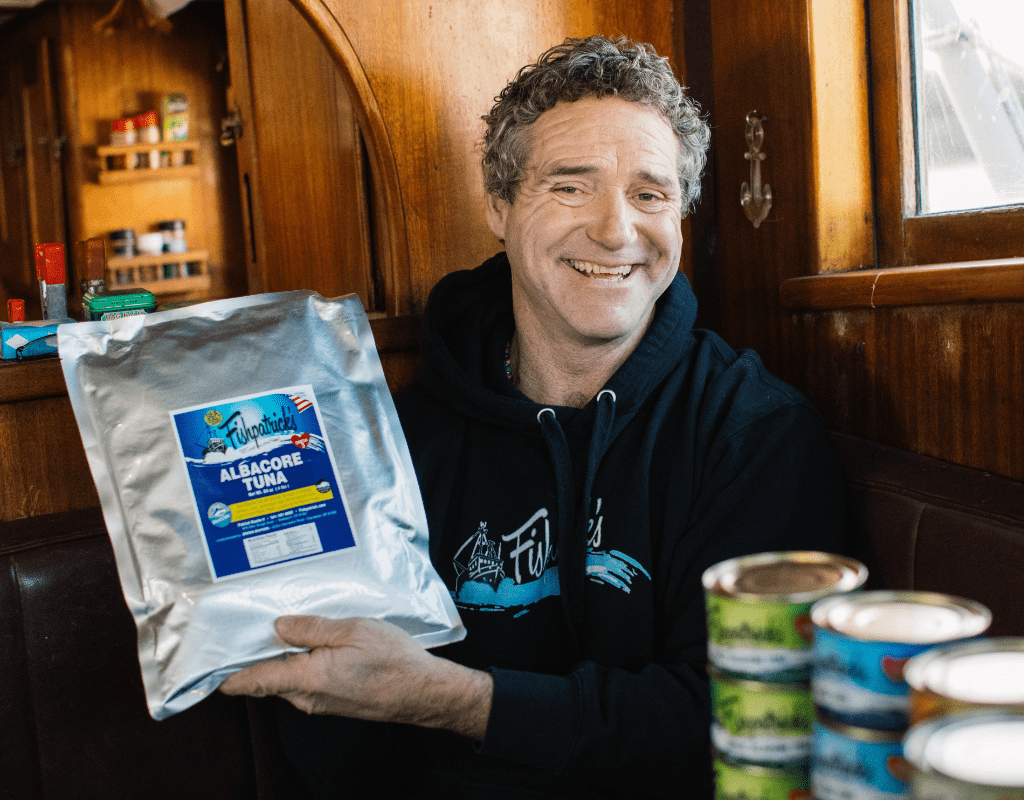
Patrick Roelle from Fishpatrick’s Tuna displays a four-pound pouch of his tuna, which he sells to schools and early childhood programs. Photo credit: Emilie Chen
Thomas and Patrick met to discuss how to feature Fishpatrick’s tuna in the school district’s lunch program and, together, they determined Fishpatrick’s tuna is eligible to be purchased using Oregon Department of Education NCRG funds. Thomas helped Patrick sign up to be listed on the Oregon Harvest for Schools Directory, an online database that school food buyers can use to find Oregon producers who are ready to sell to schools, as well as connected Patrick with neighboring school districts that Patrick sent tuna samples to.
“I’m proud to be part of it. I’m proud that I was able to help a local businessman,” said Thomas. Patrick is a hard working, long-time resident of Reedsport and a generous individual, says Thomas. “I was glad I was able to give him the tools to connect with other schools.”
Having lived in Oregon for the past 20 years, Thomas is familiar with Oregon-grown and -harvested foods and their seasonal availability. With the money from NCRG, he focuses on featuring what is in season on his menus. It’s also an opportunity for Thomas to offer students culturally diverse foods.
“Certain farms, for instance, can supply us with spaghetti squash, acorn squash, multiple types of beautiful apples, [like] Asian apples, which is something that kids don’t typically get to eat,” said Thomas. He says the types of groceries available in Reedsport are often reflective of the local demographics and culture. Using NCRG funds allows Thomas to introduce students to foods that are different from those that they may be eating at home.
Patrick’s boat, the James Lee, docked in the boat harbor. Photo credit: Emilie Chen
The majority of farm to school work for Thomas is creating the relationships with producers. He emphasized the importance of persistence when reaching out to them.
“It’s taking the time to reach out. And sometimes you’re going to get an answering machine. You have to be persistent. They’re doing the best they can. But being a small producer, they don’t have someone sitting in the office 24/7 or, you know, even nine to five. They’re out there in the fields or out on the boats fishing,” said Thomas. He builds extra time into his already busy schedule to work with local producers and reach out to potential new producers.
“In a nutshell, I have the time, I make the time because that means I can use the funds provided to me more efficiently,” he said. Reaching out to neighboring school districts to crowdsource good potential local producers can also be helpful. In his experience, the majority of Thomas’ school district neighbors have been more than happy to exchange information to help one another. Thomas says they become stronger by helping each other.
Grant funding
Grants like Oregon Department of Education’s NCRG are essential for districts, all of which have tight budgets, that are navigating how to support producers in the community. Even though food service directors may want to support local producers, directors are often forced to go for the best (often that means lowest) price, Thomas said. Working within the constraints of a tight budget to purchase local foods—which are typically more expensive than foods from a distributor or that can be purchased as part of federal entitlements—can be difficult and time-consuming.
Thomas says the district receives a good amount of grant funding for local procurement, but the funding doesn’t last the whole school year. In an ideal world, he would be able to offer local products in his menu throughout the year, but he has to prioritize and plan his local purchases in advance because of limited funds.
“
This [farm to school] is where we want our tax money going, our tax dollars, because you can see the result. It helps small businesses. It helps small schools and large schools, it helps feed the kids.
Thomas Kyelberg, Food Service Director, Reedsport School District
The day before we spoke with him, Thomas was on a call with Oregon Representative Boomer Wright regarding the upcoming state budget, where he emphasized the importance of farm to school funding and advocated for an increase in funding.
Thomas expressed that it would be very difficult for local producers to compete with large food distributors that have lower price points. These kinds of grants really help small producers survive and grow, and benefit other school districts in the state.
“This is where we want our tax money going, our tax dollars, because you can see the result. It helps small businesses. It helps small schools and large schools, it helps feed the kids,” said Thomas. “It helps get the proper food to the kids that are desperately in need of it.”
Building farm to school community with other districts
As Reedsport’s food service director, Thomas is not only building relationships with local producers, he is also building farm to school community with neighboring small school districts.
“I enjoy reaching out to other small districts. I love my counterparts in the big districts, but I find myself wanting to reach out to other coastal school districts, because they are very small. We work as a team,” said Thomas. He says that smaller school districts have smaller enrollment numbers, so they often can’t justify having a full-time food service director. This means that it may be more difficult for smaller school districts to have the time to build relationships with local producers and utilize NCRG funds.
“Are you using your farm to school program?” Thomas will ask other school districts. “And if they aren’t, I help them with that. But if they are, I’d say: ‘What kind of produce are you picking up? And who are you getting them from? What kind of interactions have you had with them, and do they work with you well?’” These types of questions help Thomas expand his network of local producers to purchase from, bringing those resources to his school district, and allowing him to share that knowledge with other districts.
“[We] work with our neighbors,” he said, “and we have our strength by working in numbers.”